WILDLIFE INDIA
HOME : Birding Tours India : North India Birding Trip |
NORTH INDIA BIRDING TRIP  Duration : 15 nights / 16 days Places Covered : Delhi - Sawai Madhopur ( Ranthambhore National Park ) - Bharatpur - Agra - Corbett - Dhikala - Kotabagh - Nainital - Delhi 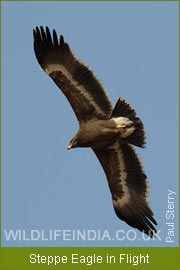 Through
this birding program we have tried to provide you with more diverse and interactive
experience of birding with special emphasis on birds of prey then available
anywhere else. Through
this birding program we have tried to provide you with more diverse and interactive
experience of birding with special emphasis on birds of prey then available
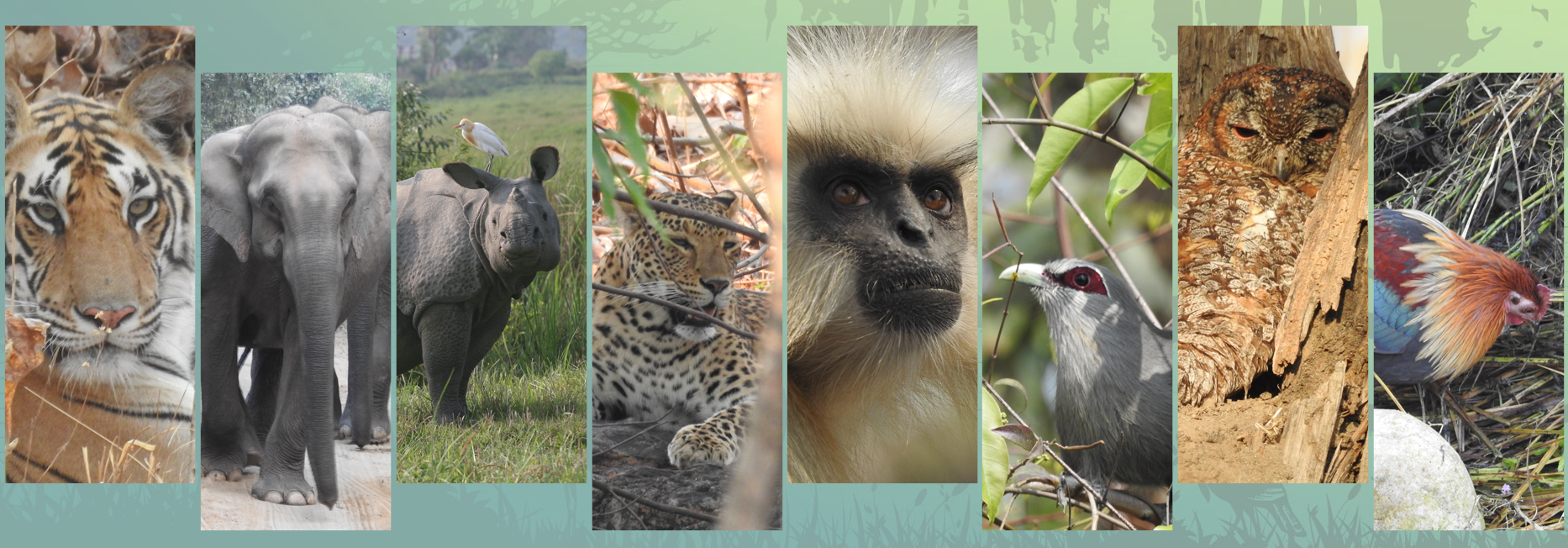
anywhere else.The exciting program is an intensive and fun adventure which involves visiting all the hot spots of birding in and around Corbett country. The program also includes learning about the birds of prey from one the last of two remaining Falconers in India. Something about Raptors: Raptors/Falcons and humans have inhabited the earth for a million years and somewhere with passge of time a bond was formed between men and falcons in the form of FALCONARY. Where and How the Falconary started is lost in the antiquity, but many believe it had its origins in Asia- amongst the nomadic tribes, whether it was Chinese or Mongols we don't know. Falcons and Hawks have always been admired- often even by those who kill them- for those who love raptors, Falconary was the greatest attraction as it spread and flourished to its highest prime in the new world - Americas. India as we know it of yore excelled in this typical art form, but sadly with the advent of the modern age, India has also been seen the demise of this noble art. Falconary un-fortunately is banned in India. There at the helm who should have helped propagate this great Ancient art were and still are the chief Architects who thoughtfully banned this sport besides jeopardizing the very existence of these birds of prey. Nevertheless some pockets of resistance survived and passed on this precious knowledge to would be Falconers. The areas around Corbett have over 50 species of mammals, 530 birds, and 25 reptiles. Our birding trip will take us to from the plains of India to the vast tracts of grasslands and densely wooded forests around Ramganga River in the Corbett and then upwards to the higher ridges of the Western Himalayas. Here in the pine-clad forests and the woodlands one can constantly come across many exotic and some times new species of birds like Red-fronted Serin, Brown-fronted Woodpecker, Black-headed Jay, Altai and Black-throated accentors, Blue-capped Redstart, Chestnut Thrush, and Vinaceous Rosefinch. You may be lucky enough to see Lammergeier sailing beneath you.  Day 01: Delhi The tour begins with arrival in Delhi. Night in Delhi. Day 02 :Sawai Madhopur ( Ranthambhore National Park ) After breakfast we start our tour with transfer to the busy railway station for a 5 hours train journey Sawai Madhopur. The journey will give you glimpses of the rural country side with occasional sightings of Indian Pond Heron, Black-shouldered Kite, Common Peafowl, Rose-ringed Parakeet, Indian Roller, Black Drongo and Common and Bank Mynas. On arrival we are transferred to the hotel for checking in and quick lunch. We depart for our first excursion in the Ranthambhore National Park in search for the elusive Royal Bengal Tiger. Overnight at the hotel. Day 03. Ranthambhore National Park : stretches across an area of 1,334 sq km on the eastern edge of the Thar Desert. Once the hunting grounds of the ruling family of Jaipur, today  it
is one of the last sanctuaries of the Royal Bengal Tiger. Ranthambhore actually
consist of not one, but three, wildlife preserves: Ranthambhore itself; Sawai
Mansingh Sanctuary; and Keladevi Sanctuary. The park is an oasis of dense dry
deciduous forests amidst a vast tract of semi-arid scrub and thorny desert vegetation
surrounded by the hills of the Vindhyas and the Aravalis. An ancient fort lies
within the park boundaries of Ranthambhore, adding to its charm. Ravines, nallahs,
bodies of water and waterfalls add to its beauty and offer many natural hideouts
for tigers and other wildlife endemic to this park. it
is one of the last sanctuaries of the Royal Bengal Tiger. Ranthambhore actually
consist of not one, but three, wildlife preserves: Ranthambhore itself; Sawai
Mansingh Sanctuary; and Keladevi Sanctuary. The park is an oasis of dense dry
deciduous forests amidst a vast tract of semi-arid scrub and thorny desert vegetation
surrounded by the hills of the Vindhyas and the Aravalis. An ancient fort lies
within the park boundaries of Ranthambhore, adding to its charm. Ravines, nallahs,
bodies of water and waterfalls add to its beauty and offer many natural hideouts
for tigers and other wildlife endemic to this park. Our open vehicles will provide us many opportunities to view the wildlife and for the bird watchers there will be moments to see the White-Napped Woodpecker, Changeable Hawk, Painted Spurfowl. Day 04 : Ranthambhore Today we enjoy two safaris; the first early in the morning, the second late in the afternoon. We will try and look for the elusive Sand Grouse and the beautiful Indian Courser. The evening will be at leisure at our resort. Day 05 : Bharatpur Early morning transfer to the train station for a 2 hrs journey to Bharatpur. On arrival transfer to the hotel. After lunch we leave for birding in the Keola Deo Ghana Bird Sanctuary. We do the exploration on cycle-rickshaws. 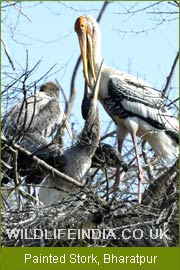 Day 06 : Bharatpur National Park Today we spend a full day exploring the incredible Bharatpur National Park. The park is 29 square Kms. in area; however, over 350 species of birds have been recorded here, with over 120 nesting species. The heronry, one of the best in the world, can have up to eight different species breeding in a single tree. The reserve overflows with huge flocks of birds: painted storks, open-bill storks, white ibis, spoonbills, various egrets, herons, and shags. It is also one of the only two known wintering areas for the endangered Siberian crane. After lunch, birders can continue their exploration of Bharatpur's mixed woodland and shallow lakes as we make a final excursion to witness the almost overwhelming number of birds, whose diversity is also, at times, unbelievable. In addition to the flocks of storks, ibis, herons, cormorants, and shags, it is possible to see four species of crane, three species of pelicans-spot-billed, white, and Dalmatian-plus huge concentrations of waterfowl and waders. Mammals include wild boar, mongoose, spotted deer, nilgai, sambar, and even otters. Rock pythons are also often seen sunning themselves. Overnight at the hotel. Day 07: Agra 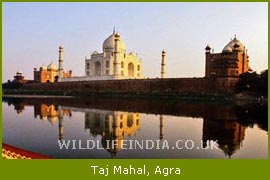 After breakfast we leave for Agra on the way we visit Fatehpur Sikri, an epic poem in red sandstone it was abruptly abandoned when the wells went dry. We arrive in Agra by lunch time. After lunch we visit the Agra Fort and its Jasmine Tower, an exquisite octagonal turret from which the Mughal ruler Shah Jahan would watch the workmen's progress on the Taj Mahal. Later we visit the Taj Mahal, one of the world's finest architectural wonders, built by Shah Jahan in memory of his queen Mumtaz Mahal. The monument usually exceeds visitors' expectations; the beauty, serenity, and symmetry leave a lasting impression as do the shrine's walls, embedded with emeralds, jaspers, sapphires, and other precious stones. Day 08 : Corbett National Park Today we leave for Corbett National Park situated in the foothills of the Himalayas. The drive will take you through countryside giving glimpse of the rural India. Late afternoon arrive at Corbett and transfer to the resort for overnight stay. Day 09: Corbett National Park We devote full day to explore the areas around the Kosi river for the Brown Dipper, Himalayan Kingfisher, White Capped Water Redstarts. This area also has the Slaty, Little and Spotted Forktails, Mountain Hawks, Long billed thrush, Rufous bellied eagles, Comman Green Magpie. The forests are also frequented by the Long-tailed Broadbill, Ultramarine Flycatcher and Blue winged Minla. Day 10 :Corbett National Park Today we enter the Corbett National Park to go into the core area known as Dhikala this area is very rich in the birdlife including mammals. Nestling in the foothills of the Himalayas, the Corbett National Park extends over an area of 1318 sq. kms. Varied topography and vegetation gives Corbett a rich diversity in habitats and natural beauty. It was the first national Park to be established in India in the year 1936 and it was here that the prestigious "Project Tiger" was launched in 1973. Corbett is avians paradise with around 600 species being recorded here and has numerous other mammalian species. Besides Tiger, Leopard one can also see Jungle cat, Leopard cat, Himalayan black bear, Sloth bear. Four species of deer- Hog deer,Sambhar , Chital and barking deer are found here. These herbivores can be seen in vast numbers in the chauds (vast grasslands with very high elephant grass). One can also see big herds of Indian elephants in these grasslands especially in summer. The Ramganga river flows through the park and a man made reservoir serves as the feeding ground for large number of birds. One can also see the Indian Marsh Crocodile along with the long snouted fish eating Gharials.Another species quite common in this area is the Common Indian Otter. Day 11: Dhikala We do full day birding in the area around Dhikala including the area next to the Ramganga reservoir. Dhikala, in the heart of theCorbett National Park, overlooks the Ramganga Valley and is populated by about 50 different birds of prey. Large owls include the Brown Fish Owl and the rare Tawny Fish Owl. You can also spot the Bright-headed Cisticola, Chestnut-capped Babbler and grassland species like Hen Harrier, Red Avadavat and the endemic Finn's Weaver. It is also the only place in northern India where the Great Hornbill, the Oriental Pied Hornbill & the Indian Grey Hornbill can be found together. Massive elephant herds congregate here in summer months. 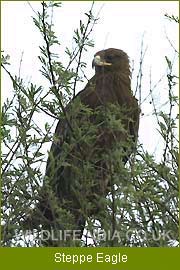 Day
12 : Kotabagh Day
12 : Kotabagh Today we leave for the Kotabagh to meet our expert on Falconry, with whom you will be interacting for next two days learning the basics of Falconry and the raptors. Kotabagh is a little vale surrounded by the last remaining belt of The Great Sal Forest on one side which carries on to Jim Corbett National Park and wooded hills on the other side. The forest in and around Kotabagh is same as that of Corbett National Park and as are the animals and most of the bird species. According to the latest findings and Bikram Grewal, author of the several best selling Indian Birds Books, a longer list of birds can be spotted in Corbett than the birding destinations of Bharatpur, Chilka or Nal Sarovar. Similarly Kotabagh with its various walk in spots has excellent bird sightings. In the surroundings of the Peregrine Lodge itself many species of Raptors can be spotted some of which are, the Himalayan Shaheen, the Besra Sparrow Hawk, the Shikra, The Oriental Hobby, Jungle Hawk Eagle, Black Winged Kite, Goshawk etc. Day 13 : Kotabagh Day spent in and around the Peregrine Lodge in Kotabagh looking for raptors and hawks. Simultaneously learning and trying hands in making hoods and other stuff used in the art of Falconry. Day 14 : Nainital This morning we drive to the old hill station of Nainital. A delightful journey on high mountain roads stopping enroute to look for birds including Long-tailed Broadbill, Black-throated Jay, Black-throated Tit, Blue-headed Redstart. Night in Nainital. Day 15 : Nainital Today morning we drive up to the ridge above Nainital which overlooks the mighty ranges of Himalayas. On a clear day you will be able to Nanda Devi, the second highest peak in India (24,500 fts). This area is rich in Gray-winged Blackbirds, Oriental Turtle Doves, Chestnut-crowned, White-throated Laughing thrushes, and Orange-flanked Bush-Robins. A gentle walk down the hill will bring many additions of birds to your list including Dark Breasted and Pink-browed Rosefinches, Hill Partridge, Golden Bush-Robin, Altai Accentor, White-tailed Nuthatch, Rusty-cheeked Scimitar-Babbler, Yellow-breasted Greenfinch and Common. From your perch on the hills you can also see the Himalayan Griffon, Lammergeier and Steppe Eagle flying in the surrounding valleys. Day 16 : Delhi We drive back to Delhi today stopping enroute to take photographs of the rural India including occasional birds to be seen in the cultivated fields and the shallow pools. On arrival you are transferred to your hotel room till your flight back home. NORTH INDIA BIRDING TRIP RESERVATION FORM |


 Bharti SoftLand