WILDLIFE INDIA
HOME : Species of India - Bears Family
of India |
BEARS FAMILY OF INDIALike all other animals, the origin of bears is also from the Northern Hemisphere. In India three species of bears are found, The Himalayan Black Bear, The Brown Bear and The Sloth Bear.Bears can easily be recognized by their heavy body, thick coat of hair, protruding lips and lumbering gait. Bear’s have very good sense of smell which in a way overcomes the handicap of poor hearing and sight. Out of these three species of bear, The Himalayan Black Bear is the most sharp and cunning animal. Living in the forests up in the Himalayas it follows the migratory pattern by coming down in the winters and that is the time when maximum conflicts happen with the humans. By nature all bears are very good swimmers, the Polar Bear being the best example. The largest bear species found in the world is from Alaska where the Brown Bear have reached at least 600 kg plus in weight. In India The Black Bear and the Brown Bear are found in the Himalayan ranges whereas the Sloth Bear is found all over the peninsular India. The Brown Bear is known to live in the higher reaches of the Himalayas whereas the Black Bear inhabits the forests of lower Himalayan range. 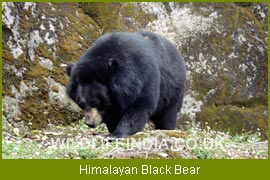 The Himalayan Black Bear (Selenarctos thibetanus) The Himalayan Black Bear (Selenarctos thibetanus)Himalayan Black Bear is a large yet compact of all three bear species found in India. It can reach a length of 5-6 ft and when standing it can be a formidable sight and foe to tackle with. It has a smooth black shining coat than the sloth bear and has a distinct V shaped mark on the breast. In India it is found right from Kashmir till Assam in the Himalayan ranges from a height of 5000 ft till 12,000 ft. In winters it tends to come down lower in the valleys to look for food in the maze and corn fields and in summers it goes higher in the mountains to look for the berries, nuts, pears, apricots and the honey. Insects and termites makes for its staple diet. Himalayan Black Bear is very aggressive by nature and can attack without any provocation. It has been observed to kill goats, sheeps and occasionally small mules of the villagers and the herdsman. During the winters when it comes down from the hills to look for maize and corn the maximum number of man/animal conflict happens. The breeding in Himalayan Black Bear takes place usually in autumn and the cubs are born at the end of winters or early spring. Generally 2-3 cubs are born in one litter. The Brown Bear (Ursus arctos) The Brown Bear of Himalayas is heavier in build and weight than the Black Bear. It’s brown coat is easily recognized in the higher reaches of the mountains. It prefers to live and search for food in the altitude above the tree line. It is usually found near the snow line looking for food in the higher pasture or underneath the rocks. It has been observed to have a liking for fresh growing shoots of grass. It also likes to hunt marmots and other insects. During the summer it goes in for the fruits from the orchards and likes to eat peaches, apples, mulberries and apricots. It also kills the goats, sheeps of the graziers who come to the high pasture to graze their animals. In spite of its carnivorous habit it is not known to attack human beings. During my years as a trekker in the higher ranges of Himalayas lots of my fellow trekker friends and myself encountered both the types of bears but were never bothered by the Brown Bear. However, we escaped many a times the charge of a Black Bear. Brown Bear hibernates in the winter being the animal of higher reaches and comes out only when the snow starts melting. Breeding in Brown Bear is earlier than the Black bear and usually happens in early summers. Young ones are born to mothers while they are in hibernation. The Sloth Bear (Melursus ursinus) 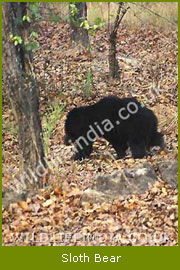 The most unkept looking bear out of three species found in India is the Sloth Bear. It can be recognized by its long muzzle protruding lip and heavy shaggy hair. It has a V patch on its breast and has comparatively shorter hind legs. Sloth Bear is found throughout India from the foothills of Himalayas till the Southern most end of India. It is also found in Assam and continues over in the neighboring countries. It is primarily nocturnal in nature and hunts for the food during the night. The ideal habitat of sloth Bear is forested area with rocky outcrops having caves and other openings. In the forests where there is hardly any human interference Sloth bear is seen in the daytime looking for the food. It mainly eats fruits, tubers and insects but termites are its staple diet. In summers when trees are in bloom and honey is plentiful, the Sloth Bears are seen very frequently either on a tree or in the hollows where it can find the honeycombs. Sloth bear has a very unique way of sucking out the termites from the base of tree trunks and from termite mounds. It digs a hole at the base of a tree or a mound and than blows the air in and sucks it out with termites along. Recently we observed a female sloth bear doing this ritual for more then one hour without being bothered of our presence. Sloth bears near villages and small towns have a habit of raiding the crops in the night to eat sugarcanes and maize crop. In the central India they have a fair liking of Mahua flower/fruit that blooms and fall on the ground. This flower/fruit also has an intoxicating effect. Breeding in Sloth Bears is usually in the hotter months and the young ones are born in the winter month of December/January. A lot of times a mother Sloth Bear has been observed carrying young ones on its back while going to look for food. She is most dangerous during the time she has babies with her and can attack immediately without any provocation. |



 Bharti Web