WILDLIFE INDIA
HOME : Species of India - The Elephant
of India |
THE ELEPHANT OF INDIAProboscidea, is the name given to the Elephants because if its trunk (Proboscis). In the present world, only two species of Elephants are found, Indian (Asiatic) and African. During the prehistoric age many species of the mammoth were founding roaming the world. The Wooly Mammoth is the best example found intact as a fossil of this species from the past.Present day elephants have two different set of teeth, one set on the upper jaw is visible as the tusks and the other set of molar has two grinding teeth which keeps on replacing at regular intervals. The process starts at the age of 2 years followed by one at 6, 9, 25, 60 and the last till it is alive. There is a saying, but not substantiated, that when the last pair of molar falls off, the elephant dies shortly after as it is unable to eat. The Indian Elephant (Elephas maximus) 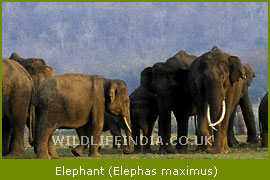 The Indian Elephant is a smaller than its African cousin. The average height of an Indian Elephant is around 8-9 ft with female being slightly smaller in size. The difference between an Indian Elephant and an African one other than the height is its ears, The African Elephant has very big ears (looks like map of Africa) as compared to the Indian Elephant, its forehead is smaller then the Indian Elephant, it has three nails on the hindfoot as compared to Indian’s four, the African elephant’s trunk has two lips at the end and the Indian Elephant has only one. In Indian Elephant only the male has tusks whereas in the African one both male and female has the tusks. Some of the male Indian Elephant are without tusks and are called “Makhnas”. These elephants are very big in size and are prone to charging. In India, The elephants are found in the lower ranges of the Himalayas, in the Western Ghats right on till the forest of Kerala, Tamil Nadu, Karnataka, Orissa, West Bengal, Assam. Elephants like Bamboo and are generally found in areas having plenty of Bamboo forests. They prefer tall forested areas for the shade and move quite a distance in search of food. In the dry season they tend to keep themselves to the denser parts of the forests but sometimes in search of food they raid the cultivation fields near the forests and the plantations causing extensive damage to the crops. Elephants are always seen in herds comprising of an extended family of cousins and aunts and is always lead by the most experienced and old female. Large males or the bulls are never part of the herds but are always seen following them at a distance. Elephants usually follow a familiar path over years and feed and rest in the same area. Elephants generally rest during the hotter part of the day while coming out to feed in the mornings and late evenings. The staple diet of an elephant comprises grass, leaves, bamboo and crops from the fields and plantations. The normal daily requirement of an adult elephant is around 250 to 300 kg of fodder. Elephants have very high sense of smell and their hearing is also very good. Sometimes an elephant mainly the male goes into musth and this is time it seeks female for mating. The main indication of this condition is a oozing of thick liquid from the glands located behind the ears. An elephant in musth is very difficult to control and many deaths (humans) have occurred especially from the domesticated elephants. The breeding season in the elephants is suspected to be the summer with a gestation period of around 20 months. Only one calf is born and the mother is always assisted by the other grown up females in nursing the calf. |




 Bharti SoftLand