WILDLIFE INDIA
HOME : Species of India - Cats Family of
India |
CAT FAMILY OF INDIAIndia is the only country in the world to have the distinction of having 3 main species of Cats in its tally i.e. The Lions, The Tigers and the Leopard along with many other smaller cat species. Even though they differ from each other in appearance yet they all belong to one single family, the Felidae.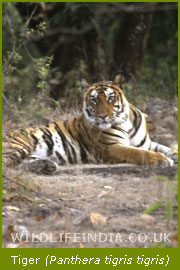 The Tiger (Panthera tigris) The Tiger (Panthera tigris)With an average length of 9-10 ft, Tigers inhabit the length and breadth of India from the lofty heights of the Himalayas to the forests of Southern India. The size varies according to the type of habitat they live in, Tigers from the Himalayas being larger in size from the ones from Central & Southern India. The Indian Tiger also known as the Royal Bengal Tiger is bright in color with well developed stripes and a short luxuriant coat. It is mainly a solitary animal keeping itself to the densely forested areas. It is only during the mating when a Tiger and a Tigress come together for a number of days. The rearing and taking care of the cubs is essentially a Tigress’s job and takes around two years till the time the cubs grow up to take independent territories. In India the remains of the tigers have been found till the altitude of 10,000 ft which shows its adaptability. It can be found in the dense evergreen forests, in the forests on the foothill of the Himalayas, in the forests of central India and in the Sunderbans where it leads a sort of amphibious life. Tiger’s survival depends on availability of adequate number of prey species, fair amount water and good foliage for cover. With rapid urbanization and de-forestation many places in India have lost the presence of Tigers. Over the years also the Tigers have been hunted as a game trophy and also under a myth of having magical curing power of many diseases. The decline in the population of the tiger has made our government aware of the grave situation facing the tiger and many remedial measures have been taken to protect and preserve this magnificent cat species. 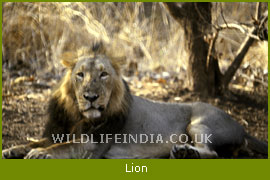 The Lion (Panthera leo) The Lion (Panthera leo)Indian Lion on first sight looks slightly smaller then its African cousin due to absence of mane. But it makes up on this with a tuft of hair on its elbows, at the end of its tail and on its belly. The average length of Asiatic Lion is around 9 ft. Lions were quite common at one time through out Northern and Central India and there have been recorded instance of Lion hunt on the outskirts of the Delhi. At present the Lions are found only in the Gir forest in the district of Junagadh in Gujarat. This forest reserve at one time was the hunting reserve of the former Maharaja of Junagadh and on his initiative Lions were protected from their impending death. The forests of Gir are mainly palas, jambul, stunted teak with undergrowth of thorny bushes and scrubs. It is ideal habitat for the Lions to hunt and to live. Gir also has the highest density of Leopard population in any of the protected areas (around 250). The main prey basis of Lions in Gir isSambhar , Chital, Nilgai (Blue Bull), and Wild Boar and domestic cattle’s of the nomadic herdsman living in the vicinity of the Gir reserve. The Gir Lions have been observed to mate during October/November with gestation period of around 115-120 days. Unlike Tigers the Male Lion usually stays with the pride and help the female to look after and to feed the young cubs. The estimated present population of Lions in Gir is around 359 and there is a proposal to relocate few prides of Lions to a new area to help preserve them and to protect the existing Lions from any man made or natural calamity. 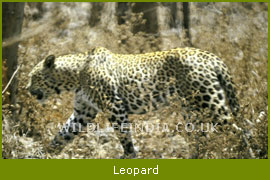 The Leopard (Panthera pardus) The Leopard (Panthera pardus)Most adaptable of all the cat species Leopards or Panthers are found almost through out the Indian Sub-continent. The Indian leopards are known to attain a length of at least 7ft with female being slightly smaller in size to the male. The Leopards vary in size throughout India and normally have bright coat with small black rosettes. The color may differ depending on the area where the leopard is found. Leopard can live almost anywhere and thrive on almost anything. They are found in the deserts, in the hills, in the snow, in the dense forests, in the open grasslands, near the towns and villages. Other then the large prey species the leopard can hunt and kill every type of animal, birds like peacocks, partridge, porcupines. In the vicinity of villages the main prey of the leopards is the dog. They occasionally turn into cattle lifters and it sometimes result in man-animal conflict resulting in an animal becoming a man-eater. Leopards breed throughout the year and generally 2-3 cubs are born per litter. The gestation period in Leopards is in between 85-95 days. The Clouded Leopard (Neofelis nebulosa) With its longish body and tail but with smaller length then the Leopard from plains the Clouded Leopard is more beautiful in appearance. The color of its coat is bright yellowish brown with tawny color on the under parts. It has stripes on its face like the smaller cats with two set of band running along the sides from ears to the back. The broad patches form a sort of clouded pattern on the body with tail having ornamental rings. Clouded Leopard is found in the forests of Assam especially the areas of forests bordering Bhutan and Nepal. The Clouded Leopard inhabits the dense evergreen forests hunting in night hence is very difficult to see. It has very powerful jaws and has very big upper canine teeth which make it easier to kill deer and other large animals. It also has a tendency to turn into a cattle lifter like its other cousins in India. The Snow Leopard (Panthera uncia) Smaller in size then its brother from the plains the Snow Leopard has thick coat of soft grey fading to snow white with a longer bushy tail. The rosettes are less noticeable on Snow Leopards and the main distinct feature is its high forehead with short muzzle. Snow Leopard is found throughout the Himalayan range right from Kashmir to Bhutan. It is now on the verge of extinction due to its large scale hunting for its pelt. The normal habitat of the Snow Leopard is in the higher altitudes of the Himalayas sometimes reaching heights of 12-13,000 ft. mainly because of the inhospitable terrain very few studies have been done on the behavior of Snow Leopards. Snow Leopard hunts during the nights and its main prey base is the wild goats and sheep of the Himalayan range, Himalayan hare, marmots and occasionally birds. It also kills the domestic sheep & goats of the herdsman in the high pasture lands. On the setting of winters it migrates to the lower areas in search for food. The cubs born per litter are normally 2-3 and the gestation is for 3 months. The Marbled Cat (Felis marmorata) The Marbled Cat found in India is slightly larger then the domestic cat and has a rich thick brown coat. It is physically quite different from the other cat species of its genera i.e the Leopard cat, it has a broad and more rounded head with wider cheek arches. The most recognizable feature on these cats is the pattern on the coat; it has stripes on the neck, back and the head with marbled spots on its flanks. It is sometimes confused as being the young one of the Clouded Leopard due to its color and pattern. Marbled Cat in India is found mainly in Assam and neighboring Nepal and Bhutan. It inhabits the dense forest and is quite adaptable in climbing trees to catch the birds and other rodents. It is quite rare to be observed because of its nocturnal habit. The Leopard Cat (Felis bengalensis) The Leopard Cat looks like a dwarf Leopard due to its color and the markings and is of a size of the domestic cat with rather long legs. The color pattern of this cat varies from region to region and is usually yellow on the top with white below. It also has couple of bands from the crown running along the neck and shoulders. The Leopard Cat is found from the forests of Kashmir till the southern most tip of India at Cape Camorin. It is quite nocturnal in its habit and hunts small birds and other animals. In some of the areas where this cat is found near the villages it is known to kill the poultry of the villagers. There are instances of Leopard Cat breeding with domestic cats. There is another sub species of this cat known as the Rusty Spotted Cat found in the Western Ghats till the tribal areas of Gujarat as well as in Kashmir. It has bars and spots in a regular line with markings changing from brown on the head to rusty on the flanks. It is found in the open grasslands, scrub and the jungle. The Golden Cat (Felis temmincki) The Golden Cat is the largest of all smaller cat species. It has no clear marked pattern on its body and has a golden brown shining coat. The most prominent mark is usually found on its face with a horizontal white or buff stripe running from below the eye to behind the gape. Sometimes there can be a curved line running from above the eye to between the ears. In India it is found in Sikkim and Assam and neighboring Nepal with further extension into Burma and S. East Asia. It is known to kill even the young calf of cows and buffaloes. It generally hunts poultry, goats, sheep’s and smeller deer’s. 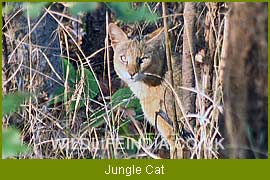 The Jungle Cat (Felis chaus) The Jungle Cat (Felis chaus)Most widely found in the entire Indian sub-Continent, The Jungle Cat has a short tail and long legs. The color of its coat varies from sandy grey to yellowish grey. The one found in the Himalayan range has a heavier coat and the one found in the plains is smaller in size and weight. It is also found in the desert and has a sandy color. It inhabits the drier and more open parts of the forests mainly the grasslands, scrubland, and reeds on the river banks. It is quite bold and can be seen to hunt in the daytime also. It is very swift in its movement and is known to seize its prey twice its size. We have seen a kill of a peacock in one of the national parks made by a Jungle Cat. The Desert Cat (Felis libyca) The Desert Cat is easily recognized by its color of the coat, which is pale yellowish with black spots on it. The end part of its tail has a black ring and the chin, throat and the breast are spotless and white. Its ear is also like the Jungle cat but is pale in color with black hair at the tips. It co-exists with the Jungle Cat in many areas be it The Thar Desert of Rajasthan or the dry arid land of Central & Western India. It is quite an elusive animal and very less is known about its habits. It preys on small birds, rodents and other insects found in the desert and the dry arid land. The Caracal (Felis caracal) The Caracal closely resembles Lynx in its look; it has same broad head with tufted ears but is lighter in build with a longer tail and no hair around its face. Its coat is soft with a uniform reddish grey color. It range covers the drier parts of Central India, Uttar Pradesh, Punjab and Rajasthan. It is highly elusive and is rarely observed in the wild. It favors the scrub jungle and hunts the birds, small mammals, antelope and deer’s. It is known for its agility and is capable of springing quite high in air to catch the birds in flight. It rears it young in the burrows or crevices in rocks but not much is known of its breeding habits. The Lynx (Felis lynx) A slightly heavier cousin of the caracal, The Lynx has most distinguishing feature- long straight tufts of hair at the tips of its ears. It has a short tail and a fringe of hair around its face. Its coat is much thicker then Caracal and has a distinct pale grey or isabelline color. In India it is found in the upper ranges of the Indus valley including Ladakh and adjoining Gilgit and Tibet Lynx favors the cover provided by tall grass, patches of willow scrubs and reeds on the higher ranges. It hunts and kills birds, hares, marmots, partridges, pheasants and occasionally sheep and goats of the herdsman. It also follows the seasonal migration of animals in the high altitude Very little is known about its breeding habits as it is quite difficult to observe due the terrain in which it lives. The Pallas Cat (Felis manul) It is smallest of all the Cat species, much smaller then the domestic cat also. It has short widely separated ears set very low behind the cheeks and a distinct low forehead with a long-tail. It has an advantage on other cats due to the formation of its ears and the forehead as it can easily lye low and observe its prey without being detected. The color on the face is normally grey with other parts of the body either silvery or darkish grey. It has rings on its tail and a black end. The coat on the chest, belly and on the thighs is considerably thicker and acts as protection when lying or resting on the snow. It inhabits the desolate high ranges of Ladakh and Tibet. Nothing much is known of the habits of this species due to the extreme ruggedness of the terrain it inhabits. |




 Bharti Web