WILDLIFE INDIA
HOME : Species of India - Dog Family of
India |
DOG FAMILY OF INDIAEveryone is familiar with the dog, its characteristics, and its family bonds and to term it further -as a friend. Wolves, Jackals, Foxes and wild & domestic dogs all compose this family, the CanidaeOut of all beasts of prey The Canidae are most widely distributed. As with the other species the origin of this species is also from the Northern Hemisphere with gradual spread to other continents except Australia. In India also the wolf, the fox, the jackal and the wild dog all came to India from the North. Out of these the Jackal has been most successful in adapting to the country, living in the mountains, the desert, the forests and the plains. The fox and the wolf adapted themselves to the open countryside and the wild dogs to the forested area. All these species are in no way different from there cousins from the northern latitude. The only difference being the size which is bigger in the species found in the northern latitudes. The Wolf (Canis lupus) 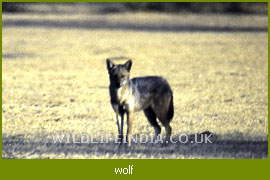 Wolf is most easily recognizable of all the Dog species because of its size and shape. The color varies from sandy fawn to blackish in wolfs of plains and the Himalayas. In India it is found in the higher altitudes including Ladakh and Kashmir and in plains it is found in the desert areas of Rajasthan and Gujarat and the open plains of the central India. Wolves are seen in the forested areas but their general preference is for the open countryside. In the Himalayan region they migrate as per the movement of the local herdsman and of other wild goats and sheeps. There shelter comes from caves and holes and cavities in the rocks. In the plains and in the desert they prefer burrows or the relative shade of the thorn bushes. In India they have known to become child lifter in certain areas due to paucity of prey base and due to continued encroachment by humans on their habitat. In the open grasslands of Rajasthan, Gujarat, Andhra they regularly hunt the black bucks, chinkaras, hares and even foxes. The normal breeding happens at the end of monsoon and the gestation period in wolves is 60-65 days with cubs born by December. The Jackal (Canis aureus) 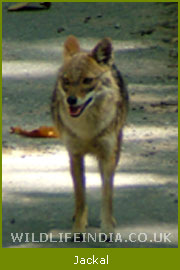 Nearer to the wolf in shape it is smaller in size and more cunning. It’s howling in the night especially near villages is an indication to its presence even though it is not seen by the people. The color of the coat varies from season to season with mostly black mixed with buff. In India it is found variably every where, in dense forests, in open plains, in deserts. It is known to be at the heights till 10-12,000 ft. In virtually all the hill stations in can be found in the neighborhood. In the plains it can be frequently seen near the villages and small towns. Jackals usually are seen in a pair but they do sometimes form a pack to hunt big animals. Near the villages they are known to become poultry thieves and often kill goats and sheeps. There is no proof of its attacking any human being until unless it is a rabid Jackal. In the forested areas they have been seen killing large deer, like a male Chital, but in a pack. During the cultivation and ripening of crops they have been known to raid the fields ripe with musk melon, water melon and sugar canes. Jackal also have known liking of the fallen berries. Cubs are born throughout the year in Jackals and the gestation period is like Wolves, 60-65 days. The Red Fox (Vulpes vulpes) This a beautiful fox with rich luxurious coat having reddish tinge with upper half of the ear black and tip of its tail white. In India it is known to exist in the Himalayan ranges in Ladakh, Kashmir till as far as Sikkim and in the North-Western fringes of the dry desert zone. In the Himalayas it favors the terrain of cultivated fields, in the desert area it prefers to live among the sand dunes, in the dry river beds. Red Fox shelters in burrows in the grounds or amongst the rocks. They prefer drier areas more to the wetter ones. Red Fox comes out mainly in the night to look for the food and the staple diet is small birds like partridges, rodents and other insects. They are known to pair for the life and usually hunt in pair. In the Himalayas the Red Fox’s main diet is the marmots, hares and squirrels. In the desert they look for sand rats and lizards and other small insects. Red Fox remain partner for the life and make home same den for the entire duration of their life. As a safety the burrow always has more than one entrance. The normal gestation period in Red Fox is 50-55 days and six to seven cubs are born in one litter. The Indian Fox (Vulpes bengalensis) 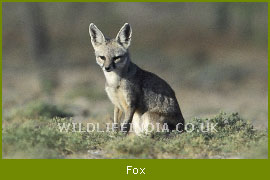 Most commonly sighted Fox on the plains is the Indian Fox, a very pretty, slim and smaller fox than the Red Fox. The color of the coat is normally grey with tip of the tail being black. Its distribution is in entire India right from the Himalayas till the southern most point of India- Cape Comorin. The Indian Fox prefers to keep to the open countryside rather then the forest areas. It is found in areas next to the villages preferably in the cultivated fields and the bunds bordering the water channels. Its habitat is same throughout India, scrub land, cultivation fields, and rocky hills. It makes its den in a burrow in the ground and each burrow has several openings as a mean of escape. Being nocturnal in habit it comes out in the night to look for food hunting mainly small insects, reptiles, rodents, and after the rains –termites. Indian Fox living near the villages becomes a sort of thief entering the premises to sneak out with food. Being small in size its main defense against any attack is its speed and dextrousity. The main breeding season is in winters and the gestation period is 50-55 days. Usually 3-4 cubs are born mainly in between February till April. 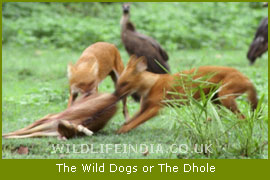 The
Indian Wild Dog or the Dhole (Cuon alpinus) The
Indian Wild Dog or the Dhole (Cuon alpinus)Smaller then the domestic dog with body like a wolf, the Indian wild Dog has shorter legs and muzzle. It has a very bushy tail with the tip generally black and well rounded ears around the tip. The Indian Wild Dog is found throughout India. Dhole prefers the shaded forests more to the open ones as it has food and water to meet its need. Wild Dogs are highly social animals always found in packs. The packs are usually an extended family with many adults and young ones. Wild Dogs are known for their steady yet tireless cater while pursuing a prey and are fearless in attacking prey many times its size. The Dhole or The Wild Dog always attacks in a pack and every individual plays its role to the perfection. While chasing a prey they seldom make any noise and are known to start eating the prey even before it has died. The most common sound associated with Wild Dogs is a “whistling” sound by which they communicate with each other. There are old records of Wild Dogs attacking and killing a Tiger. The breeding season in Wild Dogs is between November and December with a gestation period of around 70 days. The pups are born by February and every litter has around 5-6 pups. |



 Bharti Web