WILDLIFE INDIA
HOME : Species of India - Apes Family of
India |
APES FAMILY OF INDIAUnlike Africa in India we have only one species of Apes which even though is an ape yet is not one to be classified as one of the Great Apes (Chimpanzees & Gorillas). It does has distinctive build of an ape-arms are longer than the legs and the body is tailless.Hoolock Gibbon ( Hylobates hoolock) It is the only ape to be found in India and is generally to seen in the forests of the North- East India and neighboring Bangladesh and Burma. The males have a black coat and the females can be distinguished by their lighter coat having grayish color. Hoolocks prefer to live in small groups in the hilly forests and feed on tender leaves, fruits, and insects including spiders. Their main source of water is from the dew which forms on the leaves. The young ones are normally born in the winter months between December and March. The average height of a Gibbon is 3 feet and the arms are normally double the length of its legs. Monkeys Monkeys in India can be classified as one from same family – Cercopithecidae, but with two subfamilies- Cercopithecinae and Colobinae ( macaques and the langurs). Langurs are taller then the macaques which are smaller in size and are sturdier build. Macaques have cheek pouches to store food whereas langurs have pouches in their stomach for storing food. 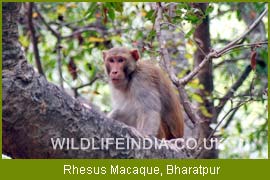 The Rhesus Macaque (Macaca mulatta) The Rhesus Macaque (Macaca mulatta)The most common monkey seen in the entire Northern India including the Himalayas is the Rhesus Macaque. The males are heavier in build then the females and this species can be easily distinguished by its reddish fur on the loins and on the rump. The male can reach height of around 2 feet and can weigh almost 10 kg with females around 1 to 1 ½ ft and weighing 5-6 kg. Rhesus move around in big troops and can be seen almost every where- be it a village or a town. As with other species of macaques Rhesus also have a male dominated system. They are known to raid the crops and are quite aggressive in their behavior. Rhesus prefers open grounds as their habitat and even in some of the forest areas of India they like to remain in the periphery. The preferred food for Rhesus is ground plants and insects but they are known to adapt well to their surroundings. The Bonnet Macaque ( Macaca radiata) This species of Macaque is slightly smaller then the Rhesus and can be distinguished by its long tail which longer then its body. Its distinct feature is its bonnet of thick hair on its crown. The coat varies in between the season with darker brownish coat in the winters with whitish underparts and a dull grayish coat in the summers. This species of Macaque is found mainly in the Southern parts of India with river Godavari acting as its northern most barrier. As with Rhesus this species can also be found near villages and on the periphery of the forests. The feeding habits are also same as of Rhesus- fruits, berries, tender leaves, insects etc. This species of Macaque has a more socially active life with highly organized troops living in very well defined territories. They mate throughout the year with young ones being born from January till April. The Assamese Macaque (Macaca assamensis) This macaque is the heaviest of all the macaques found in India. It can weigh up to 12 kg and is taller then the Rhesus. The only distinguishing factor for this macaque from Rhesus is the absence of any color on its rump and loins. It is found almost in the entire Himalayan range eastward from Uttaranchal and also in the forests of Sunderbans. The Assamese Macaque has same habits as Rhesus but is less aggressive in its behavior. It ranges from the heights of 2000 ft till 6000 ft and usually descends down on the foothills around the main towns looking for food. They are normally found in the denser parts of the forests and live in groups of varying sizes. Unlike other macaques their call is more musical and when faced with danger they have a peculiar habit of jumping down from the trees and escaping in the dense bushes. They feeding habits are like other macaques. They are widely hunted by the local tribesman for food and also due to misconception about the medicinal value of their flesh. The LionTailed Macaque (Macaca silenus) This species of macaque is different in appearance from all other species of macaques. It has a thick mane of long dark-grey hair around its cheeks and temple as well as a darker coat. It is mainly found in the Western Ghats from the Northern Karnataka till Kerala and in some areas of Tamil Nadu. This species of macaque inhabits the denser parts of the evergreen forest of the Western Ghats ranging between 2000-3500 feet. These monkeys also live in groups like other macaques but are very elusive in their behavior. The call of the male species of this monkey closely resembles human voice. Instead of jumping from one tree to another like other monkeys the LionTailed Macaque climbs down and walks on the ground to reach the other tree. Due to its habitat destruction this species of macaque is facing danger to its existence. Langurs 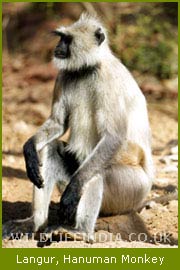 The Common Langur or the Hanuman Monkey (Presbytis entellus) This species is the most commonly seen in the entire Northern, Western, Southern and Central India and can be found in the Himalayan range till at least 12,000 ft. The Himalayan langurs are heavier then the ones found in the peninsular India and also have a heavy coat the peninsular ones. The langurs found in the Himalayas, in the Peninsular India and in the Southern parts of India, even though differ in color, and are actually sub evolved races from single species. The Himalayan langurs have slightly pale whitish heads with darker body; the ones in peninsular India have darker hand and feet and the ones in Southern India have very pale color of their coat. Langurs can be found anywhere in India, forests, villages, towns, they are quite adaptable to live with humans. They owe much of their existence to the religious belief of the Hindus and because of this they are seldom harmed. Their feeding habit is quite opposite to that of macaques and is not considered as the crop raiders by the farmers. Their main enemy in the wild is the leopard. On seeing a predator they give out a guttural alarm for rest of the group to become alert. Being less aggressive then the macaques, Langurs have a very mild dominance interactions within the groups. In Northern India April-may is the time for the younger ones to be born and in Southern India much of the younger ones are born in January-February. The normal gestation period in Langurs is 6 months and a mother usually takes care of the young one till at least two years. The Capped Langur (Presbytis pileatus) With physical characteristics same as the Common Langur the main distinguishing feature is the cap of hair on the forehead going backwards. The distinguishing feature is its color – darker on back and limbs in contrast with golden red on it’s under parts and cheeks. The Capped Langurs are found from Assam to the neighboring areas of Bangladesh and in the hills of Upper Burma (Myanmar). All together there are five sub species (races) of the Capped Langurs in the hills of Assam & Burma all distinct from each other because of their color. The Capped Langurs lives in the dense forests of the hills of Assam and the Burma. This species of langurs always keep to the trees and hardly come downs to feed and drink even though this area is very rich in water source with many streams flowing through the forests of these hills. They fulfill their requirement for water from the dew and the drops of water on the leaves and are purely vegetarian in their feeding habit like other langurs in this sub-continent. Due to their elusive nature and habitat Capped Langurs behavior is very less known but what ever is known about their behavior indicates behavior similar to other langur species. This species of Langurs is also known as The Leaf Monkey due to their habitat preference. The Golden Langur (Presbytis geei) 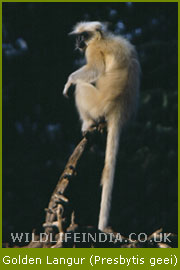 This is species of Langur in the Indian Sub-continent the Golden Langur derives its name from the color of its coat which is cream throughout and looks golden in the bright sunshine. The feeding habits observed indicate habits similar to the other langur species as being vegetarian. The habitat of this species of langur is a forest tract between India and Bhutan in the forests of the Manas. National Park half of which is in India and rest in Bhutan. The Nilgiri Langur (Presbytis johni) The main characteristic feature of this species of Langur is its shining black coat with yellowish-brown head. The females have a patch of white on the inside of thighs. The Nilgiri Langur is found in the Western Ghats from the Coorg region till Cape Comorin. This species of Langur favors the dense evergreen parts of the forests< also known as Sholas, covering the Western Ghats and the range generally covers levels from 3000 ft till 7000 ft. Like other species of langurs this one also is vegetarian in their feeding habit but is known to raid the plantations in the Western Ghats to look for the tubular plants. Due to extensive destruction of the forests, which now have been replaced by the plantations, the habitat of Nilgiri langur has also suffered and as a result the population of Nilgiri langur has gone down quite drastically. The Nilgiri Langurs troop varies between 8-9 langurs and has a single male leader. The birth of young ones is normally in the month of June. Lemurs Out of all the primates, The Lemurs lack any resemblance to the humans. Their long snout they look more like a fox then a primate. Their body structure as well the brain has levels which are considered lower then the primates. But their well developed hand and feet closely resemble the primates. In India we have only one species of the Lemur, the Lorises, rest of the species of them are found in Africa especially in Madagascar and the south-western Asia. The Slow Lorris (Nycticebus coucang) A purely nocturnal animal, The Slow Lorris is found in the forests of Assam, neighboring hill tracts of Bangladesh and Burma. It is very rare to be observed and mostly comes out in the night to eat fruits, leaves and insects. It is very slow in its movement and sometimes gives an impression of being too deliberate. The Slow Lorris has a round head with round eyes with brown circles giving it an owl like appearance. The distinguished feature of Slow Lorris is its second toe with claws and other toes with flat nails. It has a thick fur with varying color and a distinct brown stripe from middle of its back till the head. The Slender Lorris (Loris tardigradus) This race of Lorris resembles Slow Lorris but is lean in its appearance with longer limbs and more pointed snout. The coat is less thick with varying color with few flecks of silver. The prominent stripe of Slow Lorris is less visible in the Slender Lorris. It is found in the Southern India and has same nocturnal habits as the Slow Lorris. Unlike Slow Lorris, the Slender Lorris can be seen in the open patches of the forest also including the plantations. It favors anything which can be caught and eaten by it. The main items favored by it are the lantana berries. Slender Lorris is usually found solitary and sometimes in pair. |



 Bharti Web