WILDLIFE INDIA
HOME : Species of India - Ungulatres of
India |
UNGULATES OF INDIAThe ungulates also known as the hoofed animals have their own class distinction due to the shape of their toe. The Cattle, sheep, goats, deer and pigs are one family (Artiodactyla) and horses; rhino’s and tapirs are part of other family (Perissodactyla).The Asiatic Wild Ass (Equus hemionus) 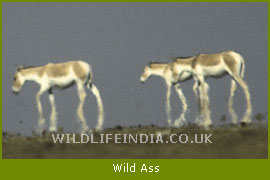 In India the horse family (Equidae) is represented by The Asiatic Wild Ass also known as Ghudkhur. The main feature of the horse family is the formation of their hoof which has complete toe encased in it. Zebras, Asses and horses are all part of this family. The Asiatic Wild Ass has a pale chestnut coat and has a dark brown mane which extends till the tail. The belly and the inner parts are while in color. In India the wild ass is found in the Little Rann of Kutchh and can be seen in this vast expanse of plain marshland with small little islands known as the bets. These bets are a sort of islands of grass in this vast expanse of land. During the monsoon when this entire area gets inundated by floods the Ghudkhur or the Wild Ass take shelter on the high grounds of the Bets. In the dry weather these small group of asses tend to congregate together in the bets where there is still some grass and water for feeding. The Wild Ass or Ghudkhur’s beauty and grace amazes all who see them. We have seen a Ghudkhur run along with our vehicle neck to neck for many minutes at a high speed for quite some distance. The period of gestation in Wild Ass is around eleven months and the mating takes place during the months of September-October. Some attempts were made to tame these wild animals but were not met with success. There is one more place in India where Wild Ass is found, in Ladakh. They are leaner and have a darker reddish coat than their cousins from Rann. They prefer high plateaus of the ladakh. The second family of the Ungulates is sub-divided in many smaller families and the oxen, sheeps, goats, the antelopes and the gazelles constitute the largest of them. They are all clubbed together in a single family known as the Bovidae. All these animals have feet which is ideally suited to the terrain they inhabit and are built for quick movement. Due to the shape, the size and structure of the toes these animals are also called the ‘cloven-hoofed’ animals. Being vegetarians these animals require large quantity of food. The main staple diet of these animals is grass and found more in the open areas. As remaining in open areas bring more danger to them, nature has provided them an escape. All these animals have four chambers in their intestine. They swallow their food hastily without even chewing it and later in relative safety they ruminate or chew the food. The Bovidae family has horns which are there for life long. They do not shed their horns like deer’s do. The Gaur (Bos gaurus) 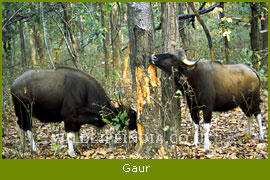 The Gaur also known as the Indian Bison is largest of all the ox family in the entire world. An adult bull can reach height of more than six feet at the shoulders with exceptional girth of horns. The females are slightly smaller than the males with shorter yet sturdier horns. A fully grown adult male can easily reach a weight of 800-1200 kg. Gaurs are quite distinct in their appearance with huge head, massive body with highly muscular shoulders and white stocking on the legs. The young ones are golden yellow when borne and then turn to reddish brown as they grow. In India, Gaurs are found from the forests of Central India down to the forests of southern states and West Bengal onwards till the forests of North east India. Gaurs generally prefer the denser part of the forests and like to keep on the hills and hilly slopes full with bamboo growth. They come down in summers when the water and food is scarce and can be seen in the meadows grazing on the grass. Gaurs are by nature very shy and avoid any sort of contact with humans. It is very rare for them to come out and raid the cultivation fields and plantations of the villages especially in the south India. In the north-east India especially in Arunachal Pradesh, Gaurs have been known to mate with the domestic cattle and the hybrid breed is called ‘mithun’. It has similar features as Gaur and has great importance in the hill tribes of the north east. In the forests of India, Gaurs have nothing to fear from except occasional killing of semi adults and younger calf by tigers. Only thing they suffer is from rinderpest and foot-and -mouth disease which is contracted from domestic cattle they come in contact with. These diseases can wipe out entire population of Gaur in an area as happened in the forest of Bandipur couple of years ago. Gaurs live in small herds of 8-12 animals and are mainly constituted by a single family. Bulls can be seen throughout with the herds of females and young gaurs. The hierarchy in Gaurs is mainly settled on size and age and the older bull always has its say while mating. Gaurs by nature are non-territorial and always keep within their range. Occasionally during the time of draught or scanty rains many herds come together to graze. The Yak (Bos grunniens) 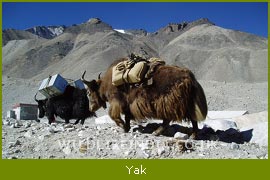 The most unique animal to the Indian sub-continent is the Yak. Found in the temperate forest of the Himalayas Yak’s original home was central Asia. It inhabits the alpine altitudes of the Himalayas and the Tibetan plateau. An adult Yak mainly the bull can attain height of at least 6 ft and can easily weight about 500-600 kg. Yaks found in the wild have high humped shoulders, straight back with short legs. It has course hair which covers its chest, shoulder, thigh and the belly. The dense coat of hair protects it from the biting winter of the higher altitudes. In the summer this mat of hair starts falling from the body and the nomads use this hair for making cloths and rugs for protecting themselves for cold. The coat of Yak is darkish brown with little white color on the muzzle. The wild Yak has horns which are bigger in size then the domesticated ones. The domesticated strain of the Yak with domestic cattle is known as Dzo in the local language and is used for transporting men and supplies at these high altitudes. The domestic breed is of two types one with horns and other without horns and has few speckling of white color on their coat. The domestic breed is sturdier then the wild one and becomes the main stay for the local villages providing them with wool for cloths, milk and occasionally meat. In India Yak is found in the higher reaches of Ladakh and neighboring valleys and in Sikkim. In summer Yaks migrate to the higher altitudes sometimes reaching the heights of 20,000 ft. In winter they don’t descend below the levels of 14,000 ft. In summer they graze on the grass and shrubs growing on high plateau and in winter they migrate long distances to search for food and sometimes die in this process. The sight and hearing is poor in Yaks but their sense of smell is very high. The breeding in Yaks is generally in October and the young calves are born in April. The Wild Buffalo (Bubalus bubalis) 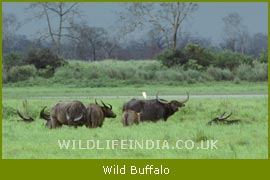 The Wild Buffalo looks quite similar in appearance to the domestic buffalo but is more heavy and agile looking. It has massive set of horns curving outwards from the head sometimes the average spread is about 1 m. In India they were once found in big herds in the state of Madhya Pradesh, Orissa, and West Bengal, Assam but are now found only in riverain plains of Assam and some parts of Chattisgarh, Jharkhand (both part of former Madhya Pradesh) and Orissa. The tall grass in the swamps is the ideal habitat of Wild Buffalos as it provides them with enough grass to feed on and water for drinking and to lie in and mud wallows in which to roll. In the swamps of Assam they prefer to lie during the day in the shadow of high grass or simply wallow in the shallow polls. They graze in the nights or at the dawn and dusk when it is relatively cooler. In the forest of Bastar (Chattisgarh/Jharkhand) they move around looking for food and can cover quite distances in the hills and valleys. They are the most boldest and aggressive of all the bovine species. They are tolerable to humans and can be seen in the neighborhood of human settlements. Wild Buffalos are known to raid the cultivated fields during the growing of crops and can cause too much damage without being scared away. Wild Buffalos are fearless when facing their attacker and have been known to tackle tiger easily. The mating starts in Wild Buffalos after the rains and the calves are born during the month of March to May just before the rains start. There are some instances of Wild Buffalo breeding with domestic ones. |



 Bharti Web