WILDLIFE INDIA
HOME : Trip Reports |
||||
Trip Report - Wildlife Trip to IndiaDestination Covers : Delhi –Pench National Park – Kanha Naional Park - Bandhavgarh National Park - Lucknow - Corbett National Park Wildlife trip to India was extremely successful. It is seldom you see so many kind of animals during one short trip. Imagine, that just after three days all participants had see at least one tiger - several had seen more than one. In total, we saw at least ten different tigers! 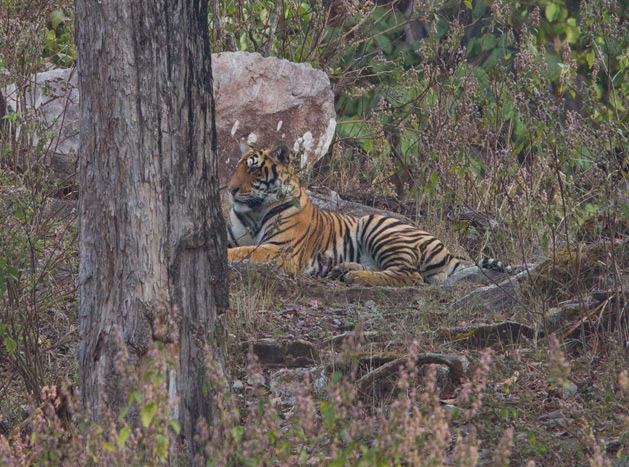
When we arrived to Pench National Park it was raining! And it rained, on and off, for a couple of days more. Maybe the bad weather made the animals more moveable, who knows? Unfortunately our tour operator, Manoj Sharma, had had an accident with his already bad neck, so he couldn’t join us during the first days. On the other hand Manoj was with us when we visited Dudhwa and Corbett National Parks, and with his extreme good knowledge he helped us to see many animals we otherwhise had missed. The animal life in Pench was adventageous to us, and we saw some animal species that are seldom or almost never seen. For example our skilful natur guide Laxmi Mudgal found a Palm Civet during day time the first day i Pench! Besides being a tiger expert, Laxmi has the eyes of a hawk and he finds animals long before we do. Just before lunch, day two, in Pench, some of us had the luck to meet dholes. It were 5-7 individuals, and even the park guides were up in the skies of happiness. We had the dholes under observation for about twenty minutes. It was amazing to see the small ’wild dogs’ play with each other so intensely. They were in constant rush or had a very short break when they just rolled over or lay in playful ambush for each other. 
In Kanha NP we had had many opportunities to study tigers. We both saw and heard at least six different tiger specimens. Most spectacular was the observation at Kanha Plains where a head of a tiger had been spotted from the road. Almost all vehicles were gathered along the road, it was raining but that didn’t disturb us (or the tiger). After thirty minutes the tiger started to move, and not long after that another tiger became visible – a male and a female! The male followed the female, and we had good opportunities to study them both for about another 15-20 minutes before they returend to the jungle. 
In Bandhavgarh we stayed at a new place, in very fine tents. Unfortunately there were thunder storms during the first night, so the electricity went bananas. And with that many camera and phone charges broke down. However, the ackomodations were very pleasant, and the surroundings were exellent. Here we saw many small birds, for example Purple Sunbirds and Oriental White-eyes, and – in the evenings – many fireflies. In a pond grow the beautiful Nymphoides indica with white delicate flowers.
 |
||||



 Bharti Web